Sunday, 13 January 2013

My little scientists!

Back to routines ...

In all honesty, I was a little bit 'scared and nervous' for school to start back up again after the two week holiday. I thought, "What if the kids cry ... What if they come back and aren't potty trained ... What if they don't like me anymore ... " Then, as they got off the bus and made their way down the hallways (picture them running, with their school bags bouncing up and down on their backs) and I saw their little smiles beaming at me, I realized that this 'fear/nervousness' that I thought I was experiencing wasn't fear at all. Instead, it was probably sadness from NOT seeing them every day! Now that we're back into the swing of things, I can truly say that I didn't realize how much I had missed them during the holidays.

What we've been up to ...

This week, we turned into scientists. I found an experiment for Borax Snow Crystals online (click here for the recipe) and we began our first 'science experiment' of the year.

I started our afternoon circle by asking, "What does SCIENCE mean? What is SCIENCE?" And these were there responses:


We brainstormed what we could be possibly making with "hot water, powder and pipe cleaners" and I took a few answers from them. I then asked students to go to a table, find a sticky note and draw what they thought would happen ... a teacher (myself, the ECE and the EA) in the room helped 'scribe' their answers.


Lots of 'explosion' predictions!


We then left it overnight and had a discussion the next day about what happened. Students sat in a circle while I walked around slowly with it, they put on gloves and got to feel it, then they were asked to draw (again on sticky notes) what did happen. So cute ... some of them said that it turned into diamonds.


One says "road salt" and the other says, "it turned into ice cubes and glass"


Later, students used magnifying glasses to get a closer look, they compared it to real snowflakes and they put it on the overhead projector to see the light shine though it... From this little 'spark,' we continued with a snow inquiry for the rest of the week. We brought snow inside and made a snowman (of course they had to wear their gloves - they were quick to realize that just because they were inside didn't mean that the snow wasn't cold!), we made observations about how long it would take the snow to melt. In addition, we made pattern block snowflakes, read a book titled "Le plus beau des bonhommes," sang "La neige tombe" (lyrics are posted under songs and chants and we also sent it home in their blue duotangs) and we continued with the literacy and sequencing that we started before the holidays with this cute little poem:


Une boule de neige.
Deux boules de neige.
Trois boules de neige.
Un nez et deux bras.
Un chapeau et un balai.
Voici, mon bonhomme de neige.


Here, you see students working at 'making a snowman' ... carrot and all!


Tada! Although the carrot nose just wouldn't stay on! We also made predictions about how long it would take to melt:

Since many 4-year olds have a hard time with 'time,' I decided to go with a basic timeframe (long time - overnight or short time - before home time).


Next week, we're planning more 'winter sports' and 'winter clothing' activities ... With the NHL back up and running, I'm sure the kids will hear lots of 'hockey talk' at home. We live in a BIG hockey community where the most used excuse for uncompleted homework is "I had hockey last night" and it's a perfectly acceptable excuse. Anyways ... I'll start them with a question: "Aimes-tu jouer au hockey?" and see where it takes us. I had my boyfriend (bless his soul, honestly) make little hockey nets. So, I'm hoping that the kinders are at least a LITTLE interested in it. Otherwise, I'll have to lie to Mitch ...

TTFN,


Pin It

Sunday, 9 December 2012

Elves in Kindergarten!

Let me start by saying that I am so lucky to work at a school that has amazing parental and community support. Our school is so blessed to have such wonderful community involvement. On any given day, parents are helping with the breakfast program, reading with students, organizing the library shelves, washing the lost and found clothes and collecting treasures at home to donate to classes in need. **Insert big virtual hug to all of our parents/guardians who make the school so successful ... we can't do what we do without you**

For example ... My principal posted a message on the school facebook page asking for any extra Christmas supplies, decorations, etc for our Kindergarten class and within just one day ... we had a full-blown Santa's Workshop. In fact, if we wanted to ... we could probably transform our entire Kindergarten class into five separate dramatic play centres: a workshop, a living room with a tree and a fireplace, a sleigh with 8 reindeer, a post-office, a forest to cut down the perfect tree ... etc. You get the idea ;)

I'll keep this post short and I'll show you (instead of telling you) exactly what we've been up to. Keep in mind, it's only been 2 days.

Wrapping presents!

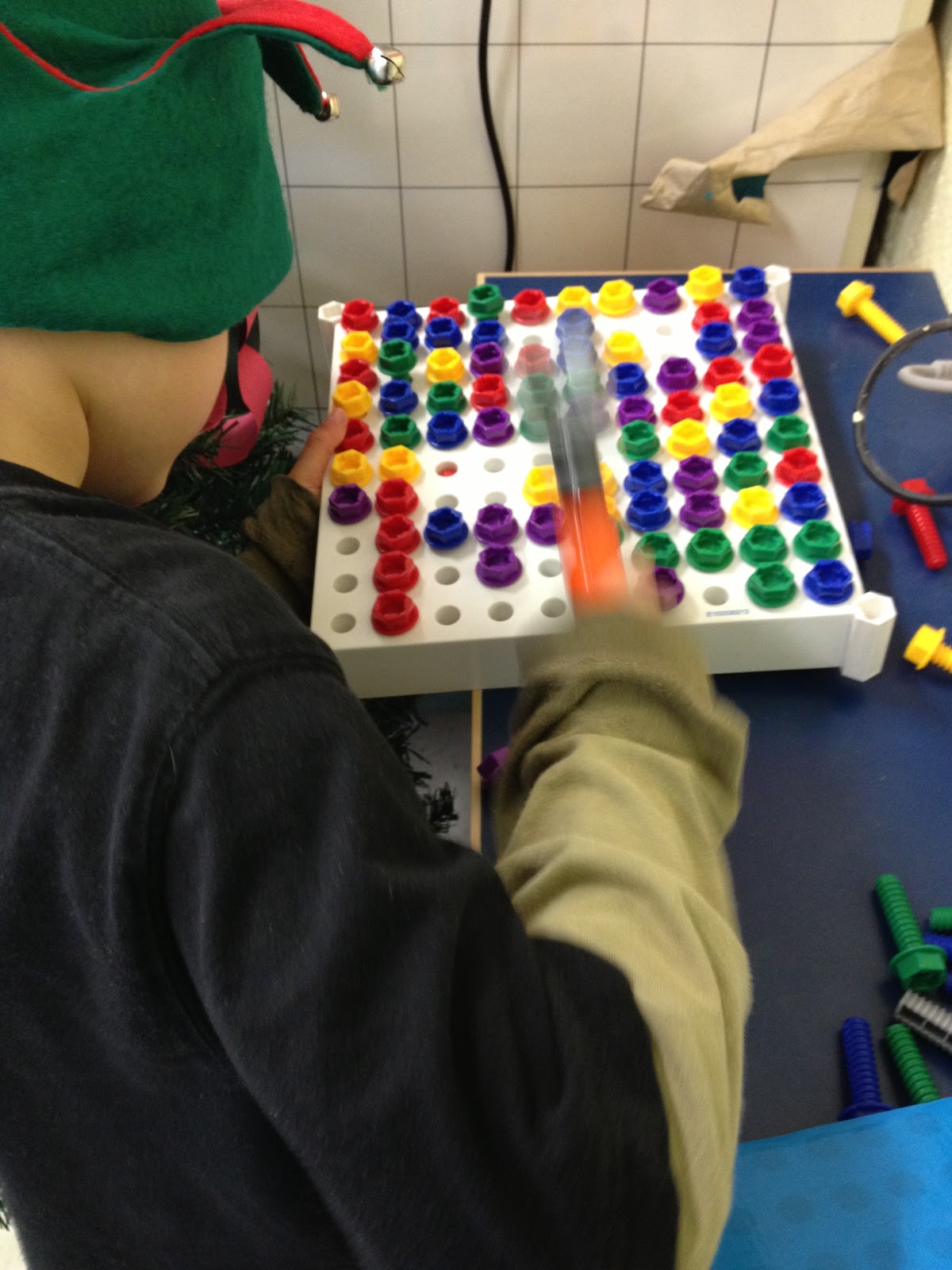
Deciding on what tools he will need ...

This little elf is hard at work making toys!

 This little elf designed her own wrapping paper (drew on white tissue paper), wrote a card, built her toy and wrapped up her gift!

 Busy elves!

Love the dialogue that comes out of the 'dramatic play centre' ...
 
 
Even though it looks like it's all fun and games ... remember that this IS the work of our little ones. From the Kindergarten curriculum document, here are some of the expectations that students achieve while "playing dress up"...
 

Social Development Overall Expectations:                                     
1.    Identify and use social skills in play and other contexts
2.   Demonstrate an ability to use problem-solving skills in a variety of social contexts
3.   Demonstrate a beginning understanding of the diversity in individuals, families, schools and the wider community
 
Specific Expectations:
  • 1.1 act and talk with peers and adults by expressing and accepting positive messages ("Oh, thanks for making me this toy, it's great!" "You're welcome, I worked really hard on it.")
  • 1.2 demonstrate the ability to take turns in activities and discussions ("When you're done with the hammer, may I please have a turn?")
  • 1.3 demonstrate an awareness of ways of making and keeping friends ("So-and-so is my friend. I'm going to make her a card.") 
  • 2.1 use a variety of simple strategies to solve social problems ("TEACHER! He grabbed the toy out of her hands!!" "Okay, thanks for telling me ... let's go talk to him.")
  • 3.1 develop empathy for others, and acknowledge and respond to each other’s feelings (After someone bumped their head on the workbench ... "Are you okay? That must have really hurt!")
  • 3.2 demonstrate respect and consideration for individual differences and alternative points of view ("He said that Santa HAS to come down the chimney but we don't have a chimney. Santa can come through the door too, right?")
  • 3.3 talk about events or retell stories that reflect their own heritage and cultural background and the heritage and cultural backgrounds of others ("At my house, we cut down our Christmas tree from a forest then we come home, put it up and have hot chocolate.")
 
The Ipads in the classroom make all of this documentation possible, while capturing pictures and providing proof and evidence for reflection and assessment for learning. But, let's be real ... we really just need a videocamera in the room, angled in every direction to capture ALLLLLL that goes on. It really is amazing.
 
TTFN,


Pin It

Tuesday, 4 December 2012

Santa's Coming!

I can't even contain my excitement...

We cleared our 'grocery store' shelves today because we had to make room for SANTA'S WORKSHOP!

To set the stage for the transformation of our dramatic play centre ... and of course, to incorporate students' ideas and interests, we started one of our circles with a discussion of 'Christmas'. We closed our eyes and visualized what 'Christmas looks like' then we brainstormed ideas, writing and drawing it out on chart paper. I prompted students by asking, "How can we recognize that it is Christmas in our Kindergarten class?" and low and behold, students responded with, "Let's create a workshop." Of course, there were some other ideas that will be recognized as well - such as having a Christmas tree, singing Christmas carols, drinking hot chocolate ... you get the idea: These kids KNOW where it's at!!

We had another discussion about HOW to create a Santa's Workshop ... they came up with all kinds of ideas. They decided that they will need tools, toys, wrapping paper, cards, elves, cookies ...

We cleared our grocery store shelves to make room for some of Santa's belongings and students got right to work with the very important job of creating the naughty and nice list.

Two students took charge to make sure that everybody's name made the list!

This little guy decided that there wasn't room on the easel, so he asked for his own paper to write down his 'nice list'. LOVE this initiative!

Next, our empty dramatic play centre needed a new sign to tell people what it was going to be!

These two girls asked me to write out a sign so that they could colour it.


Our dramatic play centre needs a few more supplies before it's ready for it's grand reveal ... but after just ONE day, it's already off to a great start! These kinders never cease to amaze me. If you have any supplies at home, please don't hesitate to send them in. Your junk really is our treasure. Little boxes, extra wrapping paper, Santa hats, elf costumes ... heehee.

TTFN,


Pin It

Sunday, 25 November 2012

Letter Recognition VS. FDK

Our kindergarten wing (a total of 4 teachers plus 3 ECEs) attended a Full-Day Kindergarten Hub this past Friday. A "hub" is a great big meeting where different schools and teachers get together to discuss/collaborate/share ideas, wonderings and successes. It's a time for teachers to be reflective, to discuss what is being done in the classrooms in terms of program implementation and possible next steps. It's a time to learn more about the program and then bring it back to the classroom to implement. It's a wonderful opportunity for teachers and admin to get together to learn from each other.

One of the questions that came up at our "hub" was, "In a play-based environment where students are directing their own learning ... how do we find the time and place to teach letter recognition?" The answer to this was (in hindsight) pretty easy: Do it through PLAY of course.

A friend and fellow teacher colleague of mine (Mlle. Farrell ... you can visit her wikispace by clicking here) created this handout to describe just what this looks like:

Play Handout

One of the concerns that teachers had (or maybe it was just me) was ... "How on Earth am I going to teach that the letter A is pronounced AH instead of EH during play centres?" And sure enough, the admin staff had an answer. They said that through various play centres and literacy centres, students will first begin to recognize the letters in their name. Naturally, they learn to do it in English first but the French language can be intertwined. By directly teaching the alphabet by singing songs, chanting it and manipulating the letters and then reinforcing letter recognition at various centres, students WILL learn it.

I then asked, "What if no one goes to the literacy station when the grocery store dramatic play centre is open?" And again ... they  had an answer. They reminded me that kids are drawn to adults ... If an adult is sitting at the literacy centre, students WILL go there. You don't have to force them, but if you're present, connected and genuinely interested in the centre then students will be right there with you.

Here are some pictures of how I've manipulated 'literacy' into play. Because in fact ... the two do not have to be separate entities.


The writing's on the .... window?! These students are using 'special' markers.

Learning their friends' names ... Always a popular centre!

Our newest (and temporary) addition to the room. A mini-Smartboard. Students don't always need a 'game or activity' ... they're happy (and fully engaged) when they're just drawing on a blank Notebook file.

I wrote out their names ... and they glued little bits of coloured paper to the letters.

Using the IPAD and the DoodleBuddy app, students took their picture and then wrote their name.
 
 
Students wrote 'sight words' in shaving cream. I had the IPAD and wrote out a word, flashed it to them and turned it into a race ...

With laminated letters and links ... students wrote their names and the names of their friends.
 
 
So, I guess what I learned from the "hub" this time around was ... keep doing what I'm doing. I learned much more ... but in regards to 'letter recognition vs. play' ... we're doing just fine. We have inquiries, we have play-time, we have balance between mini-circles and whole-group circles, we have body breaks, we have read-alouds, we have songs and dances ... the bottom line is this: these little sponges soak it alllllllll in.
 
Way to go, kinders!


Pin It

Thursday, 22 November 2012

I know why I'm a teacher.

I had a conversation last week with my mentor teacher - Mme. Moore, my emotional coach and curriculum guide - and I asked her, "Do you ever have those days when you wonder why you're a teacher?" And, she very quickly answered, "No. I never question why I'm a teacher. I question whether or not I'm doing everything that I can for my students. I question whether or not they're learning all that they can and I question how I can become a better teacher and more reflective in my practice ... But I never question why I'm a teacher. I know why I'm a teacher."

And this is exactly why I'm grateful for my mentor teacher. I don't think that I thank her enough. She's always so insightful and knowledgeable. She's honest and kind. Even when those two things don't go hand-in-hand ... she's a great listener and a great friend. Thank you, Mme. Moore for all that you do. It doesn't go unnoticed.

This week, I had the privilege to speak to parents during parent-teacher interviews and also during parent observations. When they told me that their kids LOVE coming to school, that they're singing French songs at home and that they fight over 'who gets to be Madame Kidd' when they play school ... it finally sunk in. I felt it. I know exactly why I'm a teacher and I'm pretty sure I'm allowed to have a day when I question the madness of it all ... but I will never, ever question WHY I'm a teacher again.


Pin It

Friday, 16 November 2012

Building Bridges!

We have wooden blocks. We have foam blocks. We have duplo blocks. We have lego blocks ... Let me tell you, we have blocks!

For the past two and a half months, they've built structures and towers and castles. And, they've destroyed structures and towers and castles. We've taken pictures of their structures when they didn't want to break them during tidy-up and they've tried 'recreating' them ... And we've even let them keep their 'structures' in tact to avoid meltdowns.

Something that they haven't done in the past two and half months is they haven't built BRIDGES!

Last week, I created a book titled, "Est-ce qu'on peut construire?" inspired by Megan Adams at Play to Learn Kindergarten to push the kids out of their comfort zone. After all, isn't that reaaaaalllly what FDK is all about??

Megan explained it as, "a book full of structures ... some from around the world like the London Bridges, some from our country like the Scotiabank Place and some from our community, like our school." Found some pictures on the internet, laminated them, put a ring through it and ... tada! Our 'Can We Build It?' book of structures!

This is a prime example of what 'planting a seed for inquiry' looks like in Kindergarten. I made the book and put it in the block centre and explained it to a few students and it 'took off' all on it's own. Not to mention ... from this book, I found out that students are amazed with the bridges! Why ...  hello, next inquiry.


This is a girl being the 'site manager' ... describing to everyone what to do next.

But wait ... they could use the piece that already looks like a bridge from the train tracks. Duh! Why didn't I think of that?
 
While I was sitting there, playing with the kids, one of the girls asked what the words said. I read, "London Bridges" and she exclaimed, "LIKE THE SONG?" ... Naturally, we then broke out into a sing-song ... 

And, when they compared their bridge to the picture they noticed that they were missing something ... boats! So, they used the trains as boats. Maybe we need to get some boats!

No word of a lie, I turned around to the computer station and this kinder was on abcya.com on a game called, "Build the bridge". Are you kidding me?!

Okay, now that I'm all fired up again and excited about our next inquiry, I'd better get to planning my next steps! Thank goodness it's the weekend!

Any ideas on how to probe their thinking and extend this inquiry?!


Pin It

Monday, 12 November 2012

All because of a cardboard box

One of the hardest things about teaching in the new FDK program is being able to "let go" of the reigns and let the children guide the program ... guide the curriculum, their classroom, what they learn, and how they learn it ... and then steering them in the right direction, probing their higher-order thinking and getting them to ask questions and present their findings or solutions. It really is a whole new way of teaching!

Let me take a step back. Deep breath in ... and I'll start by explaining what this looks like in our classroom.

Last week, we had an empty Halloween chip box in our recycle bin. One of our curious little kinders picked it up out of the recycle bin and asked, "What's this doing in there?" I explained (to the best of my ability) why it was in the recycle bin, but for him, this just would not do. I looked up from our conversation and noticed about 20 eyes on us. I had no idea that 4 year olds really were more interested in the BOX than what's inside the box. I ran with the idea ... I walked around the school and found about 4 more big boxes that we could "play with".

During centre time, I made sure that the cubby area was clear and we put the boxes in there to play with. Students climbed in, they pushed one another, they slid across the floor, they started a bumper-cars war (okay, that didn't really happen, but I'm sure that if I wasn't sitting right there with them then it would have happened) ...


As one student climbed in, I closed up the lid on her and knocked on the outside of the box and said, "Little pig, little pig, let me in!" ... and to my surprise, she responded, "Not by the hair of my chinny-chin chin."

TAAADAAAAA! Lightbulbs went off. From a planning perspective, there is so much that a Kindergarten teacher can do with "Les Trois Petits Cochons." I could not have been more thankful for that kinder to pull the chip box out of the recycling bin  ... It was just the inspiration that I needed. And besides, I had been meaning to start an AIM play with them! From this day, we have since read "Les Trois Petits Cochons" a few times (and they're starting to 'read' it and chime in - yay!), we have drawn the story and we have created both LARGE and small 'house' replicas. Here are some visuals:


Youtube video of the AIM play, "Les Trois Petits Cochons." This isn't me ... but I also look this crazy when I 'read' the play. Haha.


The first little pig in his straw house.
 
 
Students were asked to make 'pig puppets' and they were given a variety of tools but they were not told HOW to make them. LOVE the creativity that came out of this.

 
Creating popsicle-stick houses. Another 'thought-provoking' activity because we could NOT get those houses to stick together.

These centres were presented as 'choice' centres ... students were not told that they HAD to complete a puppet or a house, or a drawing ... but because most of them are interested in the play and the story, they are interested in the follow-up activities. In a nutshell, even though the students were steering where they wanted their learning to go, I was right there directing them and pushing them to their limits, giving them problems to solve and questioning their process. For the adults in our room (always at least 2, usually 3, sometimes 4 ... and maybe even more!) we posted some 'open-ended questions' to help guide the students. At any centre, at any point in time, we can ask things like, "What would happen if ... " and "What made you think of doing it that way?"... questions to probe vocabulary and get students thinking about the process of their learning.

Our questions are posted WAYYYYY up high. Not at the students' level at all because they're there for the adults in the room.
 
 
I promise not to ever disappear again (it's been 3 weeks since my last blog - eek!).
 
Sorry!!
 
TTFN,


Pin It